Monday, December 4, 2017

'Tis the Season...

I've gathered together some vintage photographs and postcards to say "May your days be merry and bright..."
Printed in Germany for U.S. market, 1911


Birds were popular Christmas card subjects, c.1907-1915


There are many versions of Santa.
For collectors, Santa in colors other
than red are highly sought after.
A & S Publishers, c. 1906
Real Photo postcard, c. 1910
An idyllic snowy landscape framed
 in holly was a common theme.
 This card was mailed in 1908
Cats were also popular Christmas card subjects, c. 1907-1915
Printed in Saxony for U.S. market, c. 1905-1915

Armstrong-Melick family, Roseville, Ohio, c. 1907

John Winsch design, copyright 1913
Jos. Hoover & Sons Publishers, 1916
Daisy Margurite Melick, Roseville, Ohio, 1904

Sunday, November 12, 2017

A Very Brief History of America's National Day of Thanks

Thanksgiving is our one true national holiday, celebrated by virtually every American. Although we point to the "First Thanksgiving", the meal shared by Pilgrims and Native Americans in 1621, as the start of it all, there was no National Day of Thanksgiving until the Civil War.  On October 3, 1863, President Abraham Lincoln issued a proclamation that the last Thursday of November was to be "a day of Thanksgiving and Praise" for "the whole American People...in every part of the United States, and also those who are at sea and those who are sojourning in foreign lands...."

In the 242 years between the "First Thanksgiving" and Lincoln's proclamation, there was no
consistency or continuity to the observance of a day of thanksgiving. Several states, especially those in New England, held a yearly celebration, but not necessarily on the same day; occasionally a President invited Americans to observe a day of thanks (George Washington issued the first request on October 3, 1789), but it was not an annual event, and no such presidential invitation was issued between 1815 and 1863.

Thanksgiving continued to be celebrated the fourth Thursday of November until 1939. That year, in an attempt to urge Americans to shop more and early for Christmas, President Franklin D. Roosevelt moved Thanksgiving to the third Thursday of November. In 1941, at Congress' urging, F.D.R. permanently returned Thanksgiving to the fourth Thursday.

Americans aren't alone in enjoying a national day of thanksgiving. Many countries have a yearly thanksgiving celebration, which, like ours, is really a day to give thanks for the harvest. In 1621, what the English colonists celebrated was the fact they'd had their first harvest, thanks to instruction from the Native peoples, and weren't going to starve to death that winter. From Canada to Korea and many nations in between, people of the world annually give thanks for the earth's bounty.

From the late 1800's to early 1900's, many Americans exchanged Thanksgiving postcards of either
a serious or humorous nature with family and friends. The colorful and intricate illustrations were
 beautiful reminders that Americans had many reasons to be thankful. If you are lucky enough to
 have an old family postcard album, you will likely find some Thanksgiving cards in the collection.


Saturday, October 21, 2017

The Strangling Angel of Children


Quarantine poster from the 1880's
Disease and mishaps that cut lives short, often in terrible ways, dogged our ancestors' footsteps. Family historians are familiar with high rate of children's mortality before the 20th Century. Federal censuses of the 1800's "record" the sad loss. A child born in one decade but absent in the next almost always means death occurred between the ages of newborn infant and 10 years. A host of frightening diseases for which no treatment or cure had yet been found attacked people of any age, but were especially virulent in the very young and very old.

Charles Hergesheimer, my grandmother's older brother, contracted diphtheria in July, 1878 and died. He was just seven years old. I can imagine the shock and fear my great-grandparents must have felt when Charles' diagnosis was pronounced. They had two small daughters, aged 5 and 3, who certainly had been exposed to the disease, so my great-grandparents faced the terrifying possibility of losing all three of their young children.

Quassia
Belladonna
Diphtheria, like so many of the diseases feared by our ancestors, is barely known about today. But from the 1600's, when its symptoms were first recorded, until the development of an effective vaccine in the 1920's, diphtheria was a deadly bacterial disease. Highly contagious, it was spread by coughed or sneezed droplets, close contact with an infected person, or touching objects contaminated by the infected person.

Diphtheria's onset was gradual, mimicking a cold. First there was a sore throat, and maybe a cough, but then hoarseness set it, and a fever began, accompanied by severe headache. Within a day or two, a leathery pseudo-membrane began to form at the back of the throat. Swallowing and breathing became difficult. The breath took on a putrid odor so peculiar as to be instantly recognizable as a diphtheria symptom. Attempts to remove the thick false membrane were unsuccessful; not only did the removal cause extreme rawness and bleeding, the membrane grew back at an alarming rate. The neck and face swelled, and the child eventually suffocated, hence the characterization of diphtheria as "the strangling angel of children."

Bottles of homeopathic remedies
The mortality rate for diphtheria was very high. Today, when it does occur, the mortality rate is 5-10%, but at the time my great-uncle contracted it, mortality among children is thought to have been 50-80%. Our Family Physician*, a popular book of treatments found in many late 19th and early 20th Century American homes, says of diphtheria: "In strong constitutions, the chances for recovery are favorable, if treatment is begun at an early period. If, however, the treatment has been delayed for a day or two after the symptoms show themselves, the chances are very much lessened....The longer the false membrane is in forming, the more unfavorable the results to be feared." Death occurred within 2-7 days.

My great-grandmother helplessly watched
the "strangling angel" take her eldest child
Immediate isolation in a well-ventilated room was the first measure taken for treating diphtheria. Our Family Physician offers four pages of suggested homeopathic, allopathic, and herbal treatments. Recommended remedies to relieve the patient's suffering could only have made matters worse: the poisons belladonna, aconite, mercury iodide, or creosote oil were mixed with benign substances and ingested; the throat was painted with dilutions of poisonous and tissue-burning muriatic (hydrochloric) acid or silver nitrate; a mixture including poisonous turpentine oil was used to gargle. Hot ashes and salt wrapped in a flannel were applied to the swollen neck. Fortunately for the suffering patient, the mixture of sodium sulfite and quassia oil, claimed to be "an excellent remedy to destroy the membrane", was relatively benign, but couldn't prevent the damage done by the other medicinal remedies.

If the child were strong enough to survive both the disease and the treatments, recovery took months, and was often never complete. Our Family Physician notes: "Several disorders are likely to follow diphtheria, the most alarming of which is Paralysis." Myocarditis, inflammation and damage of the heart muscle, was the most common complication of diphtheria, but other organs, especially the kidneys, could be left impaired. I don't know if my grandmother contracted the disease, but her sister probably did. When my great-aunt died at 72, the primary cause of death was "chronic myocarditis".

*A pdf of Our Family Physician by Henry Rice Stout, M. D. (Boston: George Smith & Co., 1885) can be downloaded for free at https://archive.org/stream/ourfamilyphysici00stou#page/n5/mode/2up


Monday, September 11, 2017

Protecting Family History: A Timely Word From Dick Eastman

In light of the twin disasters in Texas and Florida, I was going to offer some ideas of how to keep your precious family data safe, but Dick Eastman's done it for me. The following article is from Eastman's Online Genealogy Newsletter and is copyright 2017 by Richard W. Eastman. It is re-published here with the permission of the author. Information about the newsletter is available at http://www.eogn.com.

Hurricanes and Your Genealogy Data

The recent Hurricane Harvey, the present Hurricane Irma, and Hurricane Jose presently in tropical waters that might head northward all bring to mind questions, such as "How do I protect my personal belongings and information?"
I cannot speak to protecting belongings. However, I have written many times about preserving personal genealogy information that perhaps you spent years accumulating. The same procedures will also protect your family documents, insurance policies, photographs, and much more of the paper we all accumulate.
Many of the people who live through hurricanes will lose all paper documentation of their existence. Some cannot even not prove they ever lived. This is where going paperless can help.
My suggestion is to make digital copies of ALL PAPER WORTH SAVING, not just genealogy information, but also deeds or mortgage papers, bank and money information, birth certificates, passports, discharge papers, graduation and school records, medical records (especially if there is a chronic health problem), family pictures, and more. The list goes on and on. Scan each document and save each digital image to multiple locations.
For instance, you might save the copy on a thumb drive and on an external hard drive. That protects data lost from your computer but does not provide safety when your entire house is damaged or destroyed. In the case of flood waters, a burst water pipe, fires, or even the destruction of an entire house, the only protection of data is: multiple copies stored in multiple distant locations.
You can save the data to a thumb drive stored in a desk drawer at work, saved to a hard drive or a thumb drive at a relative's distant house, or to a secure cloud-based file storage service. The choice is yours to make. However, I strongly suggest you keep multiple copies both at home and in other locations many miles away.

Monday, August 28, 2017

Looking for Your Quaker Ancestors

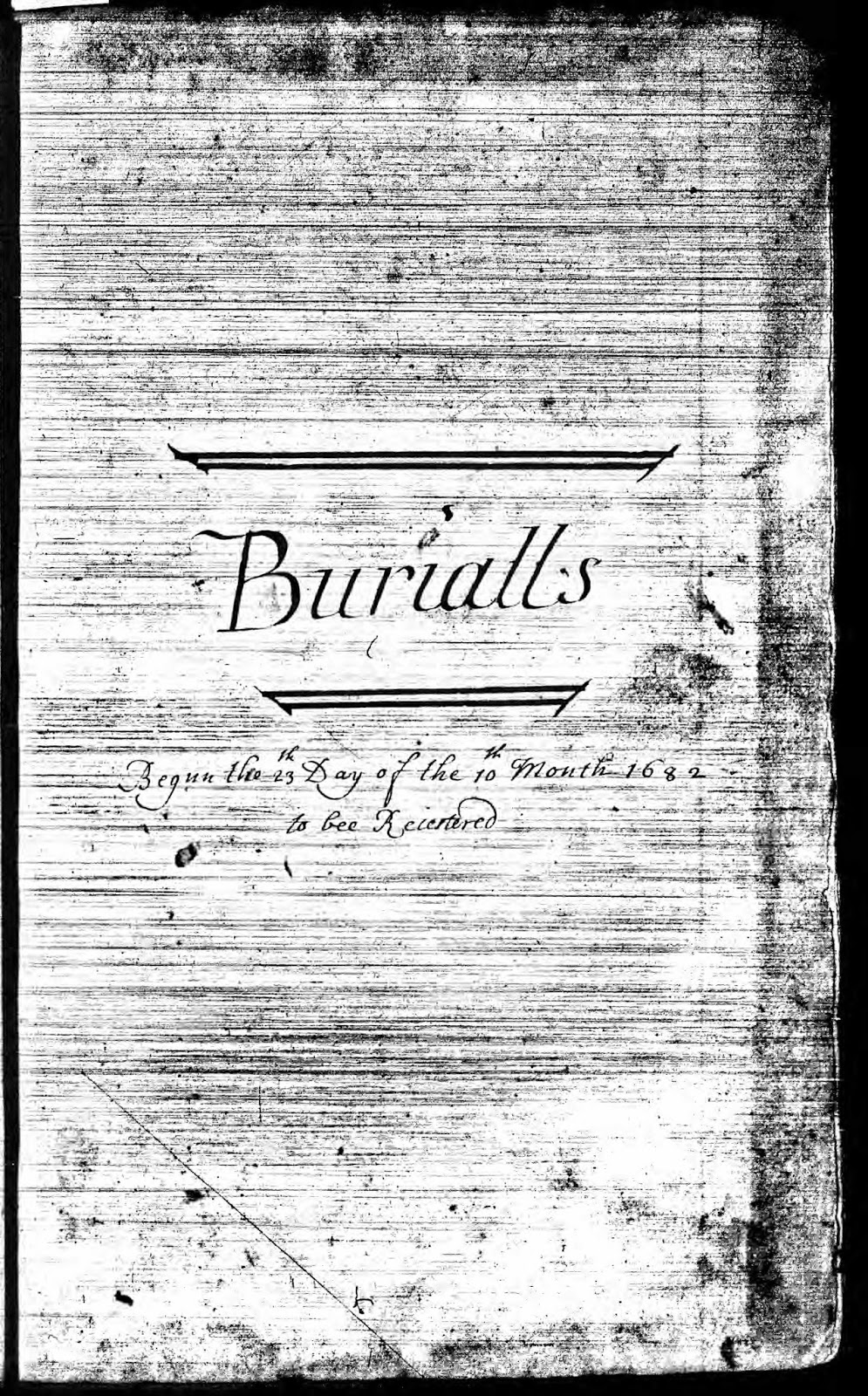
Title page of the section of Chester
Monthly Meeting "Burialls" records
"Begun the 23rd Day of the 10th
Month 1682 to be Registered".
Quaker were (and still are) meticulous record-keepers of the actions taken by their meetings, and of individuals within those meetings. In the early days, careful record-keeping was a matter of self-preservation, since Quakers were barred from access to the government institutions that kept vital records for others. Friends' births, deaths, and marriages were not recorded anywhere but in the minutes of each meeting. As a safe-guard, this vital information was re-recorded by the quarterly meeting (a collection of meetings within one area), and by the yearly meeting (a gathering of representatives from the quarterly meetings).

Quaker records weren't confined to vital statistics, however. Quaker minutes recorded a meeting's response to local and national issues in light of Quaker beliefs and practices, and reminded Friends of their duty and obligation to conduct their personal, family, and civic lives in accordance with Quaker principles.

Most importantly for researchers, Quaker minutes often afford insight into the conduct of our individual ancestors. A Friend who was particularly devout and whose words and actions were inspirations to other Friends might be appointed to a "ministry". (Such an appointment was not an elevation in a Friend's position, as that would result in inequality; it was a formal recognition of an individual's gift for helping others in their spiritual journeys.) Minutes record both the issuing and the receipt of certificates of transfer which enable a researcher to trace the movement of ancestors, and also confirm an ancestor lived her life in accordance with Quaker principles.

Whenever a major life decision was made, or whenever a friend was found to be "out of discipline", the meeting appointed a committee of two to three exemplary Friends to "treat" with the Friend. When a couple announced their intention to marry under the care of the meeting, a committee met with them to offer guidance, and to ensure both were members in good-standing. (The latter examination was especially important when a prospective spouse was from another meeting.)

When a Friend behaved in ways that were contrary to Friends' teachings, a committee counseled the Friend. All committees reported back to the meeting, and those reports were included in the minutes. The meeting as a whole then decided on a course of action, which was, of course, entered into the minutes. (By the way, Friends did not/do not vote on any matter. There is discussion--but not debate. Friends are then asked if they approve an action, and there must be complete agreement; a single dissent means the action cannot be undertaken.)

Minutes of Friends' meetings are a treasure trove for the researcher, and locating this information is not difficult. One of the most complete published sources, available in most libraries, is William Wade Hinshaw's 6-volume Encyclopedia of American Quaker Genealogy. The fully-indexed volumes consist of abridged vital and membership records, arranged by area and meeting. In addition to Hinshaw, others have compiled the records relating to just one meeting, such as Hopewell [Frederick County, Virginia] Friends History, 1734-1934.

Three years ago, Ancestry made available images of original records in the collection "U. S., Quaker Meeting Records, 1681-1935". About 80 percent of American Quaker records---11 million names!-- can be found in this collection. The early (17th and 18th centuries) records are sometimes challenging to read, but definitely worth the effort required.

The minutes of Abington Friends Monthly Meeting in Jenkintown, Montgomery Co., PA record the births
of three children of my 7th great-grandfather, William Carver: Sarah, born to William and Jane in 1690, and 
William, Jr. (my 6th great-grandfather) and Joseph, born to William and his second wife, Mary, in 1694 and 1696.

If you can travel, the archivists at these college libraries can be very helpful, plus you can see the actual records: Friends Historical Library, Swarthmore College, Swarthmore, PA; Hege Friends Historical Library, Guilford College, Greensboro, NC; Earlham College Friends Collection, Richmond, IN; Quaker Meeting Records, Haverford College, Haverford, PA. But if you can't travel, you can contact these repositories by email or letter for research assistance.

A note of caution. There are two aspects of Quaker minutes that confuse the non-Quaker researcher and lead to misinterpretation: the copious use of abbreviations, and the particular way of recording dates. At Cyndi's List  (https://www.cyndislist.com/quaker/how-to/) you can get a list of abbreviations used in Quaker minutes. An excellent explanation of how to interpret the date recorded in minutes can be found at the "Quaker Dates" section of the Guildford County, NC GenWeb site (http://ncgenweb.us/nc/guilford/quaker-dates/).


Saturday, August 5, 2017

Quaker practice

Arch Street Meetinghouse in Philadelphia.
Meetinghouses' only furnishings are benches.
As I said in last month's blog, even if you count members of the Religious Society of Friends (Quakers) among your ancestors, you might not know much about what it meant to be a Friend. You might even, as I noted in the previous blog, confuse Quaker beliefs with those of other "peculiar" sects such as Mennonites, Amish, or Shakers. A "peculiar people", by the way, was a term Friends often applied to themselves, meaning they saw themselves and their lifestyle as notably different from the mainstream.

Quakers dressed differently, in plain colors only, with no frills, bright buttons, or other decorative touches. They spoke differently, using the familiar "thee" and "thou" with everyone,--family, friend, stranger, or those of higher rank alike. Most notably, they worshipped very differently.

"The Presence in the Midst" by J. Doyle Penrose, 1916
This has been a popular painting among Quakers,
representing the ideal of Quaker silent worship.
Friends today worship in the way Friends worshipped in the 17th Century.* Friends sat together in silence, listening for the "still small voice." Anyone could hear this voice, so anyone, man, woman, or child, was welcome to speak God's message. Since God could speak through anyone, there was no need for a minister, nor for liturgy, ritual, prayer or music of any kind. There was no church building. (George Fox dismissively called churches "steeple houses", places whose very design encouraged people to believe that God could only be encountered within such buildings and under the leadership of a paid minister.) There was no creed spelling out what or how to believe about God. Quakers were (and are, whether unprogrammed or programmed) united in the belief there is "that of God in everyone", and that all thoughts, words, and deeds should be guided by a commitment to four principles: Peace, Integrity, Simplicity, Equality.

Friends' commitment to living peacefully with all, opposing any kind of violence, is well known.
William Penn's colony was founded on the principles of peaceful co-existence and non-violence. All people who would commit to those principles were welcomed into the colony. "Now let us see what love can do," Penn wrote, and his words are invoked by modern-day Quakers working to end the causes of war as well as domestic violence, human trafficking, and capital punishment.

Penn's Treaty with the Indians at Shackamoxon
by Benjamin West, 1772
Friends were expected to speak only the truth and to behave honestly in every place and situation. "Let your "yea" be 'yea', and your 'nay' be 'nay'," George Fox told his followers. Integrity--scrupulous honesty--led people to patronize Quaker businesses; It was said a small child could be sent to a Quaker grocer with a fistful of money and return with the exact order, and every cent of correct change. The commitment to integrity was the basis for Friends' refusal to take oaths or to swear on a holy book. Such demands suggested one's word is not sufficient, or that there was a different standard of truth in a court of law.

Simplicity was outwardly manifested in Friends' dress and speech, as explained above. More importantly, Friends' commitment to simplicity was a commitment to not taking more than one needed so there would be plenty of everything to go around. Friends saw simplicity as the antidote for the greed and ostentatious displays of the upper classes that deprived so many others of decent lives.

Germantown (Philadelphia) Friends Meeting issued the
earliest protest against slavery in America, 1688

Equality stemmed directly from the belief that there is "that of God in everyone." If God is in every single person, then every single person deserved to be treated fairly and respectfully. From the beginning, women held positions of leadership in their meetings. Penn's colony had the most peaceful relationship with Native Americans of any of the American colonies because Quakers dealt honestly and respectfully with them. Quakers were early leaders in the movement to abolish slavery, and later in the movement for women's suffrage. Modern Quakers continue to be advocates for those who are marginalized and discriminated against because they are perceived as "different".

If you are a Muskingum County researcher with Quaker roots in Virginia and the Carolinas, you should know your ancestors probably emigrated to Ohio because of slavery. Surprising as it might be, some early American Quakers were slave owners. Eventually, they realized the evil of slavery and so began to free their slaves. In response, the state legislatures made manumission a felony, and large segments of those states' Quaker populations opted to take themselves, and any slaves they might own, to Ohio in the Northwest Territory where slavery was outlawed.


Next blog: Sources for Researching Your Quaker Ancestors


*In the United States, there are 3 distinct branches of Quakerism. "Unprogrammed Friends" worship in the manner of the first Friends, while the other two branches ("programmed Friends") have a designated minister to lead worship which includes music. They also call their places of worship "churches", a term never used by unprogrammed Friends, whose places of worship are always called meetinghouses.


Saturday, July 8, 2017

Do You Have Quaker Ancestors?

Quite a few family researchers with early Muskingum County roots know or have at least "heard" of Quakers in their family trees. You can count yourself very lucky if you have ancestors who were members of the Religious Society of Friends, because no other religious group kept more precise records than the Quakers.

While many family historians can point to "Friend-ly" ancestors, it's probably safe to say that a large number of them know very little about what it meant to be a member of the Religious Society of Friends. There is a rather common mis-perception, for example, that Quakers, Puritans, Shakers and Amish are all one in the same, and nothing could be farther from the truth. If you have Quaker ancestors, you owe it to them to know something of the organization's history and of Quaker practices. So let's begin with a little history.

George Fox, c. 1650
The Religious Society of Friends arose in England in the mid-1700's under the leadership of George Fox.  It was one of many "dissident" religious groups rebelling in various ways against the beliefs and rituals of the Church of England (Anglican). Fox's basic message-- that God is in every person, and that every one can have direct communication with God--resonated with a great many of those dissidents, and Friends steadily increased in numbers and influence. Meetings sprang up all over the British Isles and some were established on the Continent, particularly in the Netherlands, France, and certain German states. (Germany was not one country at this time.)

The rapid growth of the Religious Society of Friends posed a problem for the Established Church and its control over the government and people's lives. Dissent was outlawed. To be a Quaker was to be subject to public harassment, imprisonment and confiscation of property. Despite persecution, Friends, unlike other dissenters, insisted on meeting in public. While that left them more vulnerable to arrest, it also increased their reputation for honesty, one of the tenets of Quaker faith and practice. That, in turn, increased the attraction to Friends, and further increased their numbers.
Interior of a typical 18th Century meetinghouse. This one was
built in Montgomery County, outside of Philadelphia, in 1708.

Like the Puritans, many Quakers came to America seeking freedom from religious persecution. The first Quakers came a bit after the Puritans established their first settlement in Massachusetts, but did not come in large numbers until William Penn was granted a huge tract of land by King Charles II in 1681. In 1682, Penn set out on the Welcome to establish his "great experiment"--a colony run according to the beliefs and practices of Friends. Thus began a huge influx of Quakers to America called The Great Migration. The Commonwealth of Pennsylvania grew and prospered immensely because of Friends' influence.

Probably most Muskingum County family history researchers will find their Quaker roots among Pennsylvania and New Jersey (originally a part of Penn's land grant) Quakers, a number of whom eventually settled in and around Loudoun County, Virginia before migrating to southeastern Ohio. Interestingly, despite the number of Quakers who migrated to Muskingum County, there is no record of any Friends meeting established here, although there is a cemetery (Dillon or Dillon Falls) thought to have originally been a Friends burying ground.
Abington (Pennsylvania) Friends Monthly Meeting birth record (1694) for William Carver, Jr. His great-grandson 
migrated from Loudoun County, Virginia to Newton Township, Muskingum County in 1808.

The next blog will look at the beliefs and practices that governed how our Quaker ancestors lived their lives.


Tuesday, June 13, 2017

Postcards and Real Photo Postcards

Postcards were first sold at the World Columbian Exposition in Chicago on May 1, 1893. The cards were issued by the government or were privately printed as souvenirs of the exposition. The government card came with a pre-printed one cent stamp, and the souvenir card required an adhesive two cent stamp. By law, neither card permitted a written message on the back--only an address. Five years later, private printers were allowed to sell postcards as long as they carried the words "Private Mailing Card". These could be mailed for one cent, but messages were still not permitted.


Charles Armstrong's postcard to his father (December, 1906) 
is an example of an early real photo card. While the law 
prevented the sender from writing on the back of the card, 
nothing prevented him from writing a message on the front.

Private mailing cards were issued until 1901 when Real Photo Postcards (referred to as RPPCs by collectors) appeared. However, messages were not permitted until March 1, 1907, when postcards were printed with a divided back. Although still being printed today, RPPCs were wildly popular between 1907-1914. If you're lucky enough to have some really old family photos, you undoubtedly have at least a few that have postcard backs. RPPCs are especially useful to family historians because they capture not only the images of our ancestors, but also of scenes familiar and important to them. In addition, these postcards often include a message helpful in identifying the photograph. Postcard writers tended to date their cards with only the month and day, if they dated them at all. However, there are ways to determine an approximate date, if not an exact date, for the card and probably for the image.

   This unmailed card of Vivian Miller (rt.)
   and a friend can be dated by the AZO
   stamp box: 4 triangles pointing up tell us
   the card was printed between 1904-1918.
   Vivian was born in 1902, so this photo
   was probably taken in 1917 or 1918.
If the card was mailed and the post mark is legible, finding the date is simple. For an unmailed RPPC, the AZO stamp box can help you determine an approximate date. (AZO refers to the type of paper Kodak used to produce RPPCs.) If the stamp box contains a triangle pointing up in each corner of the box, the card was printed between 1904-1918. If the box contains two triangles pointing up and two pointing down, the card was printed between 1918-1930. If the box contains a square in each corner, the card was printed between 1927-1940. While these are broad ranges, they can be narrowed down considerably if we know when the individual was born, as in the example at the left.


There a number of other clues on postcards, RPPC or other, which can help you date the card. For example, if you knew someone in the family was born in 1905, but didn't know when she died, finding a linen postcard written by her or to her helps you narrow her death to between 1930-1945, when linen postcards were issued.

You can learn about other clues to be found on postcards, as well as the history of postcards on a number of websites, but here are some recommendations:


Friday, May 5, 2017

The Muskingum County Infirmary

For ye have the poor with you always, and whensoever ye will ye may do them good....
                                                                                                                 --King James Bible, Mark 14:7

The admonition to care for the poor and the outcast has been around for quite some time, although the type of care provided was not often kind. In England, "paupers" were consigned to workhouses; in America they went to the poorhouse, sometimes known as the almshouse, or in the case of Muskingum County, the infirmary. Whatever the place was called, these "charitable" institutions were often inhospitable and inhumane, run by governing boards whose primary concern was keeping operating costs to a minimum. Being sent to the poorhouse was everyone's worst nightmare.

The infirmary about 1910
Muskingum County first authorized the establishment of a county poorhouse in 1816. Twenty-two years later, the county purchased one hundred acres in Falls Township to be the site for the "County Poor Farm". (Most early county poorhouses were actually self-sustaining farms.) Construction of the first "poor house" began in 1839. That building, partially destroyed by fire in 1859, was rebuilt and enlarged in 1860. In 1863, the county purchased an additional 100 acres adjacent to the original purchase, and although no longer officially called a farm, all but 30 acres of woodland was under cultivation. The building that stood on Newark Avenue until its recent demolition was erected in 1880.

The "poor house" was renamed an "infirmary" on March 23, 1850, in what today would be called a  PR move to improve the institution's image. "Poor house" was a misnomer anyway; like other poorhouses, the Muskingum County Infirmary housed not only the poor, but also those with developmental or physical handicaps, the frail elderly, and those suffering from mental illness. A page from the 1860 U.S. census of the infirmary illustrates the variety of human "condition" the poorhouse system attempted, with limited resources and understanding, to accommodate. On this page (one of three) fourteen people are listed as "pauper", sixteen as "insane", one as "deaf mute", and six as "idiotic".  One can imagine the near impossibility of adequately and compassionately serving the needs of this diverse population.


Friday, April 14, 2017

In Memory of President Abraham Lincoln

Today marks 152 years since President Abraham Lincoln was assassinated by the actor and southern sympathizer, John Wilkes Booth. Like today, that April 14 fell on Good Friday.

Lincoln was in a jovial mood when he and his wife, Mary Todd Lincoln, arrived at Ford's Theater---General Robert E. Lee had surrendered the Army of Northern Virginia to General Ulysses S. Grant just five days earlier. Lincoln had invited Grant and his wife to attend the theater with them, and Grant had accepted, but his wife, Julia, disliked Mrs. Lincoln, and convinced her husband to bow out of the invitation. After several others, including the Lincoln's son, Robert, turned down the invitation, young Clara Harris and her finance, Major Henry Rathbone, accepted.

Letter to the Editor describing funeral
observance for President Lincoln at
Zanesville's A.M.E  Church on South Street
The story is pretty well known from this point. Booth had laid his plans carefully, and no one questioned the famous actor's presence at the theater, or made any effort to impede his free movement. Booth timed his entry into the Presidential box, and the firing of the fatal shot to coincide with the delivery of a major laugh-line in the play Our American Cousin. Rathbone tried to stop Booth's escape, but was felled by a serious knife wound. Booth leaped to the stage, and was said to have shouted Sic semper tyrannis ("Thus ever to tyrants"). In his jump to the stage, Booth broke his ankle, but still made it to his waiting horse, and was able to get out of Washington before authorities could effectively mobilize to stop him. Twelve days later, Booth was tracked down and killed.

The dying, unconscious President was carried to a boarding house across the street from Ford's Theater, where he died without ever regaining consciousness early the following morning. Most Northerners were grief-stricken. African Americans in the North and the South mourned the loss of the person they considered their "Moses".

Lincoln's funeral was held in Washington, D.C. on April 19, and, as in other states, Ohio's Secretary of State asked Ohioans to hold observances to coincide with the one in Washington. One such observance in Zanesville was reported in the April 20, 1865 edition of the Daily Zanesville Courier.

Following the funeral, Lincoln's body, and that of the Lincoln's son, Willie, were put on a funeral train for a long, slow journey to Springfield, Illinois. It took two weeks for the train to travel from Washington to Springfield because of stops in major cities to allow citizens file past the casket and pay their respects. Although Lincoln's body was embalmed, undertakers had an increasingly difficult time keeping the darkening face and decaying body suitable for viewing. By the time the train arrived in Columbus on April 29, there were real concerns about the appropriateness of continuing the open casket viewings.* Nevertheless, Lincoln's body was conveyed to the State Capitol where it was on display for nearly twelve hours before the trip to Springfield was resumed. On May 4, Abraham Lincoln was finally laid to rest, along with his son Willie, in Oak Ridge Cemetery in Springfield.


"A Body for the Body Politic: The strange, sad, and gross saga of Abraham Lincoln's two-week funeral procession"

Thursday, April 6, 2017

War and Peace

Today is the 100th anniversary of the United States' entry into World War I. The European powers--Great Britain, France, Russia, Germany, and Austria-Hungary--had been locked in futile combat since August of 1914, and had managed, through a complex series of alliances, to drag much of the world into a brutal war.

President Wilson, supported by the majority of Americans, had promised the United States would remain neutral, but the fact of the nation's close ties with Great Britain strained that promise, especially once Germany began to wage unrestricted submarine warfare on merchant ships and passenger liners. The sinking of the British liner, Lusitania in 1915, which claimed the lives of 1198 people, including 128 Americans, called into question American's and President Wilson's commitment to neutrality. That commitment was somewhat restored when Germany halted its attacks on unarmed vessels. In 1917, however, Germany resumed unrestricted submarine warfare in a desperate attempt to bring the bloody stalemated war to an end. The sinking of the liner Housatonic and four U. S. merchant ships put an end to the idea that America could remain neutral; in fact, it made the American President, Congress, and citizens willing, even eager, to enter the conflict, and on April 6, 1917, Congress declared war.


Manpower-wise, the United States was unprepared for war. There were only 110,000 men in uniform at the time war was declared, and only 32,000 volunteers had come forward by the end of April.  A military draft was the only way to significantly increase those numbers, and in May, Congress passed the Selective Service Act, requiring all men between 21-31 to register for service. In September, the draft eligibility age expanded, and men 18-45 were required to register.

Images of WWI draft registration cards can be found at Ancestry.com
In the two drafts, Muskingum County draft boards registered more than 5,000 men, and 1655 entered into military service. Undoubtedly, most of those were among the 2,057,675 military men who arrived in France with the American Expeditionary Force, and joined British and French soldiers fighting the Germans along the Western Front. Seventy Muskingum County men did not return home. The county's veterans and casualties of WWI are memorialized in the E. M. Viquesney statue, "The Spirit of the American Doughboy", located on the Courthouse grounds in Zanesville. The Muskingum County statue was dedicated in 1934, and is one of 159 copies.

As we mark the anniversary of our nation's entry into a deadly conflict that did little more than set up the conditions for WWII, we should note there is another 100th anniversary this month. On April 30, 1917, a group of young Quaker men in Philadelphia organized the American Friends Service Committee to witness for peace in the midst of war. Although allowed by the Selective Service Act to register as Conscientious Objectors, American Quakers nevertheless went to the battlefields, to work with British Quakers as unarmed stretcher-bearers and ambulance drivers, caring for the wounded of any army. Many brave soldiers, wounded by war, owed their lives to brave non-combatants who rescued them from the battlefield in the name of peace.


Friday, March 24, 2017

Diseases That Plagued Our Ancestors

Title page of Robley Dunglison's
medical dictionary
In 1867, Ohio's county probate courts began to record every death in the county as a single line entry in a bound volume called a register. This was the method for keeping death records until December 19, 1908 when deaths were recorded by the Ohio Department of Health in certificate form.

You can look at images of the 1867-December 18, 1908 death records in the Probate Clerk's office at the courthouse in Zanesville. Because the death register is essentially a ledger, you see many entries on a single page--and are likely to see at least one unfamiliar cause of death on a page.

Our ancestors lived with and sometimes died of conditions and diseases that no longer plague us, thanks to medical advances. But they also suffered from health problems and diseases that are still around--we just might not recognize the disease names our ancestors used. For example, I had one ancestor who died of scirrhous pylorus (cancerous tumor of the stomach), another who suffered and then died from apoplexy (paralyzing stroke), and another whose sister died of "the wasting disease", also known as consumption (pulmonary tuberculosis).

1842 medical article about my g-g-g
grandfather, William Burdett
Thanks to the internet, we can "translate" the old medical terms into something recognizable. If you're interested in more in-depth information (and in a resource probably known to your ancestor's physician) you might want a copy of Dunglison's Dictionary of Medical Science, published in 1865. It's a collection of medical terms, anatomy, chemistry, Latin names for diseases, diagnoses, treatments, prognoses, and even suggestions for American and European health spas where your ancestor might go to "take the waters" and recuperate from whatever was ailing her.


Dunglison's has been scanned and can be purchased as a CD or download from Archive CD Books USA.


Sunday, March 12, 2017

Potters Here, There, and Everywhere

Muskingum County is famous for its pottery, and the products of companies such as Weller, Hull, and McCoy are much sought after by collectors.

George Rambo, "Farmer & Potter",
operated a bluebird pottery.
Before the big manufacturers, though, Muskingum County, rich in clay soil, was rich in small, usually family-run, potteries. These potteries often employed only two or three people, and consequently, their production was low. James L. Murphy, who compiled a checklist of 19th-century Muskingum County potteries, believed the term "bluebird" referred to the time of year these potteries produced most of their wares---the warmer months when bluebirds returned to the county. Some, however, believe the term refers to the blue designs often used to decorate the pottery. Whatever the origin of the term, there were lots of bluebird potteries. Murphy found that 190 of these small potteries existed in Muskingum County between 1850-1880. If you've looked at U.S. censuses taken in the county during those years, and especially if you've researched Newton, Clay, and Hopewell townships, you would have seen person after person whose occupation was "potter", "journeyman potter", or "farmer & potter" like George Rambo, my 3-greats grandfather. George's daughter Mary Jane, married Andrew Jackson Wilson, another bluebird potter; Mary and Andrew were my great-great grandparents.

Shards of pottery from site of the A. J. Wilson Pottery. Note
the blue painted decoration on two of the pieces.
Bluebird potteries produced practical, utilitarian pottery items for every-day use. If the pottery were decorated, it was almost always a very simple design done in blue paint, or a design etched in the clay before it was fired. There might be a maker's mark somewhere on the object. Crocks and jars of all sizes seemed to be the type of object most produced, although any household object that could be fashioned from clay was possible. I once saw a sieve made from clay; it wasn't terribly attractive, but you could see it would be serviceable.

Andrew Jackson Wilson
My great-great grandfather's business, the A. J. Wilson Pottery, is shown on an 1866 map of Newton Township. Finding the site present-day, however, was a bit tricky, but superimposing the 1866 map onto a Google Earth view of the area made it possible to locate Andrew's pottery. Nothing is visible now; the area is overgrown with tall grass. But when you walk around the site, you find yourself walking on hundreds of pottery shards and lumps of fired clay. Even though there were only broken pieces, it was exciting to hold in my hands the bits of pottery crafted by Great-great Grandfather Andrew and his son-in-law, Great Grandfather, Warren McLean (see 3/3/17 post). Being a collector of family artifacts, I, of course, brought a few pieces home.
Lump of fired potter's clay. Could the
finger impressions be A. J. Wilson's?


For more information, see  James L. Murphy's Checklist of 19th Century Bluebird Potters and Potteries in Muskingum County, Ohio, edited by Jeff Carskadden and Richard Gartley. Published 2014 by Muskingum Valley Archaeological Survey, Zanesville, Ohio.

Friday, March 3, 2017

Using Facts to Imagine Our Ancestors


Doing genealogy is about satisfying curiosity. It often begins with the purpose of discovering who our direct-line ancestors are, as far back as possible. To the names we try to attach significant dates (birth, marriage, death) and the locations where those events took place. But doing genealogy can be, and should be, so much more than drawing a straight line from one generation to another. Our research should prompt us to ask, "What was this person like?"

Warren McLean
I think of genealogy as an egg hunt, careful detective work, and a game of tag all rolled into one. Genealogy begins with our tracking down as many facts about a life as can be found, not just those three "vital" records mentioned above. Using the facts, we connect the ancestor to other people--family, of course, and friends. We then use our knowledge of history to contextualize those facts and connections. Finally, we employ our knowledge and experience of human behavior to imagine the ancestor's response(s) to events and people. Although we can never know for certain whether or not we've imagined correctly, thoughtful, educated guessing can add dimension to an ancestor, and make her come alive for us.

At the age of 17, my great-grandfather, Warren McLean of White Cottage, enlisted in Co. B of the 78th Ohio Volunteer Infantry Regiment. We know from Civil War memoirs and biographies that many boys Warren's age enlisted not just to serve the Union cause, but also to get away from the daily routine of farm life, and have a great adventure.

Warren's son,
Wade Hampton McLean
Military service documents show that Warren had an adventure all right. He was with his regiment at the ferocious Battle of Atlanta, and participated in Sherman's infamous March to the Sea, which then continued up through the Carolinas. His pension file details slogging bootless for days through South Carolina swamps. Warren did his duty, served honorably, and was mustered out with his company as a Corporal on July 11, 1865 at Louisville, Kentucky. He made his way back to White Cottage, married Arena Wilson, fathered 10 children, and supported his family as a potter.

Those are some of the facts of Warren's life. There are some post-war facts, however, that enable me to imagine how Warren felt about war, and because of them, I suspect Great-grandfather didn't like being a soldier, and didn't relish reminiscing with old comrades about the heat of battle or the tedium of camp life. The minutes of the meetings of a local G.A.R. post, for example, show Warren attended just one meeting, but never joined. When he died, his obituary, unlike the obituaries of many who served during the war, didn't mention any military service. Finally, a Muskingum County birth record leads me to believe Great-grandfather not only didn't enjoy soldiering, but disdained the entire war experience. Why else did he name his youngest son after a Confederate general? Unless, of course, he had a very wry sense of humor.


Saturday, February 25, 2017

MCCOGS' New Blog Presence

If your ancestors settled or just spent a little time in Muskingum County, Ohio, and you are a genealogist/family historian, count yourself lucky. Resources abound!

Muskingum County Courthouse
Zanesville, Ohio*
First, there's never been a major fire in the county courthouse, a tragedy experienced by many counties in many states. Consequently, nearly all the county records, dating back to statehood (1803), are in tact. In addition to the usual land and probate records at the courthouse, there are more obscure records, such as those of the Chancery Court, housed in the Records Center across the street from the courthouse. 

Second, the county clerks and their staff are welcoming and helpful, making courthouse research a pleasure. The County Recorders Office has a great website that allows you to search for historic land records online, and see a downloadable image of the recorded deed.

Third, Muskingum County has an active genealogy society. The Muskingum County Chapter of the Ohio Genealogical Society maintains its own library (non-circulating) on the second floor of the John McIntire Library in downtown Zanesville. MCCOGS member volunteers are always on-hand to assist visitors, whether they are seasoned researchers or beginners. The MCCOGS library collection is extensive, and includes a large number of local families' histories, scrapbooks, and old photographs. Some regional and national literature round out the library's holdings. In addition to maintaining a library collection and offering research assistance, MCCOGS offers classes during the year to the public.
MCCOGS has a website where members can access birth, marriage, and death record information, as well as a limited number of other county records. It also has a Facebook page which includes links to interesting articles and other websites, and every Wednesday posts an old photo of an unidentified Muskingum County resident; "Who Is It Wednesday" seeks to put a name with a face.
And MCCOGS has a new blog presence. This blog will be an olio--a hodgepodge--of topics: Family stories, township and village history, photos and other illustrations, research tips and resources, and so on. Readers' suggestions for topics, as well as your contributions are welcome. 


*Photo by David Grant 2006. This photo is licensed for public, non-profit use by  Creative Commons https://creativecommons.org/licenses/by-nc/2.0/legalcode