Monday, August 28, 2017

Looking for Your Quaker Ancestors

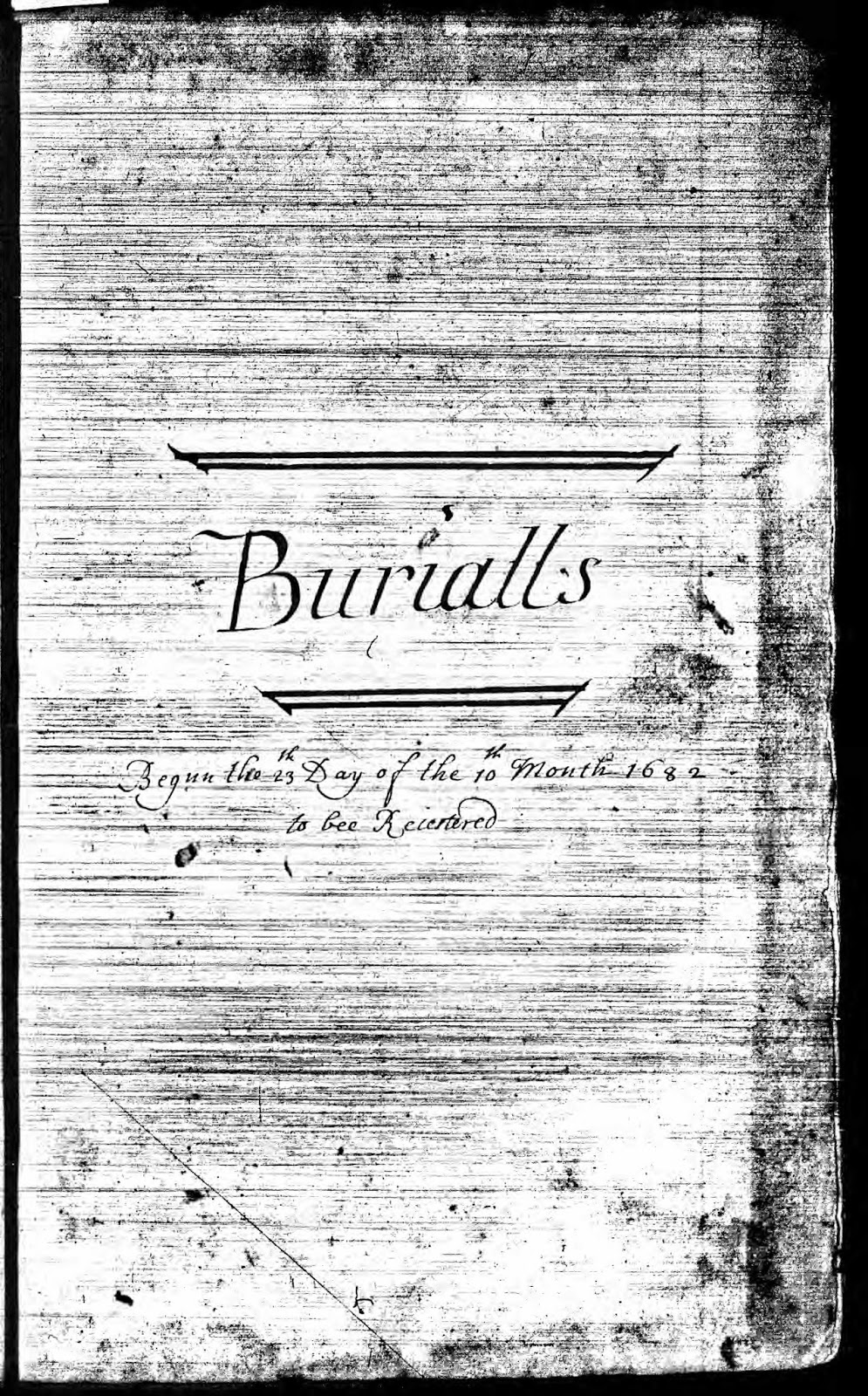
Title page of the section of Chester
Monthly Meeting "Burialls" records
"Begun the 23rd Day of the 10th
Month 1682 to be Registered".
Quaker were (and still are) meticulous record-keepers of the actions taken by their meetings, and of individuals within those meetings. In the early days, careful record-keeping was a matter of self-preservation, since Quakers were barred from access to the government institutions that kept vital records for others. Friends' births, deaths, and marriages were not recorded anywhere but in the minutes of each meeting. As a safe-guard, this vital information was re-recorded by the quarterly meeting (a collection of meetings within one area), and by the yearly meeting (a gathering of representatives from the quarterly meetings).

Quaker records weren't confined to vital statistics, however. Quaker minutes recorded a meeting's response to local and national issues in light of Quaker beliefs and practices, and reminded Friends of their duty and obligation to conduct their personal, family, and civic lives in accordance with Quaker principles.

Most importantly for researchers, Quaker minutes often afford insight into the conduct of our individual ancestors. A Friend who was particularly devout and whose words and actions were inspirations to other Friends might be appointed to a "ministry". (Such an appointment was not an elevation in a Friend's position, as that would result in inequality; it was a formal recognition of an individual's gift for helping others in their spiritual journeys.) Minutes record both the issuing and the receipt of certificates of transfer which enable a researcher to trace the movement of ancestors, and also confirm an ancestor lived her life in accordance with Quaker principles.

Whenever a major life decision was made, or whenever a friend was found to be "out of discipline", the meeting appointed a committee of two to three exemplary Friends to "treat" with the Friend. When a couple announced their intention to marry under the care of the meeting, a committee met with them to offer guidance, and to ensure both were members in good-standing. (The latter examination was especially important when a prospective spouse was from another meeting.)

When a Friend behaved in ways that were contrary to Friends' teachings, a committee counseled the Friend. All committees reported back to the meeting, and those reports were included in the minutes. The meeting as a whole then decided on a course of action, which was, of course, entered into the minutes. (By the way, Friends did not/do not vote on any matter. There is discussion--but not debate. Friends are then asked if they approve an action, and there must be complete agreement; a single dissent means the action cannot be undertaken.)

Minutes of Friends' meetings are a treasure trove for the researcher, and locating this information is not difficult. One of the most complete published sources, available in most libraries, is William Wade Hinshaw's 6-volume Encyclopedia of American Quaker Genealogy. The fully-indexed volumes consist of abridged vital and membership records, arranged by area and meeting. In addition to Hinshaw, others have compiled the records relating to just one meeting, such as Hopewell [Frederick County, Virginia] Friends History, 1734-1934.

Three years ago, Ancestry made available images of original records in the collection "U. S., Quaker Meeting Records, 1681-1935". About 80 percent of American Quaker records---11 million names!-- can be found in this collection. The early (17th and 18th centuries) records are sometimes challenging to read, but definitely worth the effort required.

The minutes of Abington Friends Monthly Meeting in Jenkintown, Montgomery Co., PA record the births
of three children of my 7th great-grandfather, William Carver: Sarah, born to William and Jane in 1690, and 
William, Jr. (my 6th great-grandfather) and Joseph, born to William and his second wife, Mary, in 1694 and 1696.

If you can travel, the archivists at these college libraries can be very helpful, plus you can see the actual records: Friends Historical Library, Swarthmore College, Swarthmore, PA; Hege Friends Historical Library, Guilford College, Greensboro, NC; Earlham College Friends Collection, Richmond, IN; Quaker Meeting Records, Haverford College, Haverford, PA. But if you can't travel, you can contact these repositories by email or letter for research assistance.

A note of caution. There are two aspects of Quaker minutes that confuse the non-Quaker researcher and lead to misinterpretation: the copious use of abbreviations, and the particular way of recording dates. At Cyndi's List  (https://www.cyndislist.com/quaker/how-to/) you can get a list of abbreviations used in Quaker minutes. An excellent explanation of how to interpret the date recorded in minutes can be found at the "Quaker Dates" section of the Guildford County, NC GenWeb site (http://ncgenweb.us/nc/guilford/quaker-dates/).


Saturday, August 5, 2017

Quaker practice

Arch Street Meetinghouse in Philadelphia.
Meetinghouses' only furnishings are benches.
As I said in last month's blog, even if you count members of the Religious Society of Friends (Quakers) among your ancestors, you might not know much about what it meant to be a Friend. You might even, as I noted in the previous blog, confuse Quaker beliefs with those of other "peculiar" sects such as Mennonites, Amish, or Shakers. A "peculiar people", by the way, was a term Friends often applied to themselves, meaning they saw themselves and their lifestyle as notably different from the mainstream.

Quakers dressed differently, in plain colors only, with no frills, bright buttons, or other decorative touches. They spoke differently, using the familiar "thee" and "thou" with everyone,--family, friend, stranger, or those of higher rank alike. Most notably, they worshipped very differently.

"The Presence in the Midst" by J. Doyle Penrose, 1916
This has been a popular painting among Quakers,
representing the ideal of Quaker silent worship.
Friends today worship in the way Friends worshipped in the 17th Century.* Friends sat together in silence, listening for the "still small voice." Anyone could hear this voice, so anyone, man, woman, or child, was welcome to speak God's message. Since God could speak through anyone, there was no need for a minister, nor for liturgy, ritual, prayer or music of any kind. There was no church building. (George Fox dismissively called churches "steeple houses", places whose very design encouraged people to believe that God could only be encountered within such buildings and under the leadership of a paid minister.) There was no creed spelling out what or how to believe about God. Quakers were (and are, whether unprogrammed or programmed) united in the belief there is "that of God in everyone", and that all thoughts, words, and deeds should be guided by a commitment to four principles: Peace, Integrity, Simplicity, Equality.

Friends' commitment to living peacefully with all, opposing any kind of violence, is well known.
William Penn's colony was founded on the principles of peaceful co-existence and non-violence. All people who would commit to those principles were welcomed into the colony. "Now let us see what love can do," Penn wrote, and his words are invoked by modern-day Quakers working to end the causes of war as well as domestic violence, human trafficking, and capital punishment.

Penn's Treaty with the Indians at Shackamoxon
by Benjamin West, 1772
Friends were expected to speak only the truth and to behave honestly in every place and situation. "Let your "yea" be 'yea', and your 'nay' be 'nay'," George Fox told his followers. Integrity--scrupulous honesty--led people to patronize Quaker businesses; It was said a small child could be sent to a Quaker grocer with a fistful of money and return with the exact order, and every cent of correct change. The commitment to integrity was the basis for Friends' refusal to take oaths or to swear on a holy book. Such demands suggested one's word is not sufficient, or that there was a different standard of truth in a court of law.

Simplicity was outwardly manifested in Friends' dress and speech, as explained above. More importantly, Friends' commitment to simplicity was a commitment to not taking more than one needed so there would be plenty of everything to go around. Friends saw simplicity as the antidote for the greed and ostentatious displays of the upper classes that deprived so many others of decent lives.

Germantown (Philadelphia) Friends Meeting issued the
earliest protest against slavery in America, 1688

Equality stemmed directly from the belief that there is "that of God in everyone." If God is in every single person, then every single person deserved to be treated fairly and respectfully. From the beginning, women held positions of leadership in their meetings. Penn's colony had the most peaceful relationship with Native Americans of any of the American colonies because Quakers dealt honestly and respectfully with them. Quakers were early leaders in the movement to abolish slavery, and later in the movement for women's suffrage. Modern Quakers continue to be advocates for those who are marginalized and discriminated against because they are perceived as "different".

If you are a Muskingum County researcher with Quaker roots in Virginia and the Carolinas, you should know your ancestors probably emigrated to Ohio because of slavery. Surprising as it might be, some early American Quakers were slave owners. Eventually, they realized the evil of slavery and so began to free their slaves. In response, the state legislatures made manumission a felony, and large segments of those states' Quaker populations opted to take themselves, and any slaves they might own, to Ohio in the Northwest Territory where slavery was outlawed.


Next blog: Sources for Researching Your Quaker Ancestors


*In the United States, there are 3 distinct branches of Quakerism. "Unprogrammed Friends" worship in the manner of the first Friends, while the other two branches ("programmed Friends") have a designated minister to lead worship which includes music. They also call their places of worship "churches", a term never used by unprogrammed Friends, whose places of worship are always called meetinghouses.