Tuesday, January 30, 2018

A Grave Matter


Rhoda's married name is incorrectly recorded on
her gravestone in Crooksville Cemetery.
Photo by FAG contributor "MissT"
My great-great grandfather Andrew Jackson Wilson of White Cottage had 19 children by two wives (and possibly one mistress, but that's another story). Topping my list of 2018 genealogy to-dos is to link each of the children to Andrew, to a mother, to a spouse, and to as many of Andrew's grandchildren as possible at Find-a-Grave. Most of these individuals already have memorials created by other Find-a-Grave contributors. Establishing links requires sending an edit request to that contributor, the only person who can make changes to the memorial.

A number of Andrew's children relocated to Crooksville in Perry County as adults, and the cemetery there is filled with Andrew's off-spring. Among them is a grand-daughter, Rhoda May Wilson, who married Wilson W. Winter in 1905. The couple had twin sons, and moved to Fredericksburg in Wayne County, where Rhoda died at the age of 34 of autointoxication (toxemia resulting from something going awry in the digestive tract). Her body was returned to Crooksville for burial.

The Crooksville newspaper incorrectly
recorded Wilson's surname
Wilson W. Winter (b. 1884) isn't buried with Rhoda, or anywhere in Crooksville Cemetery, but there is a Wilson Winter (1851-1936) in the mausoleum, where several of Andrew's children are interred. A generation older than Rhoda and Wilson W., I assumed this was a relative of Wilson W., probably---since they shared somewhat unique given names---his father. Someone had incorrectly linked the mausoleum Wilson Winter to Rhoda as her spouse.

I began searching Find-A-Grave for the correct Wilson Winter (Wilson W. Winter to be precise), but found only Wilson W. Winters, buried in a Fredericksburg cemetery. His father's name was Nicholas B. Winters, and his mother was Lydia Whorey. He was linked to another spouse. I admit that I hadn't, up to this point, paid close attention to Rhoda's husband; these folks were only collateral kin. Time to do some more research if I hoped to get Rhoda properly linked to the right spouse---and to get her unlinked from the wrong Wilson Winter, that guy in the niche.

The Fredericksburg newspaper
correctly reports the surname
          At Ancestry, I found a birth record for Wilson W. Winters born in Wintersville, Jefferson County, Ohio in 1884 to Lydia Whorey and Nicholas B. Winters. And then I found the record of Rhoda's marriage to Wilson W. Winters, stating he was born in Wintersville to Nicholas and Lydia Whorey Winters. The guy in the niche to whom Rhoda had been linked at Find-a-Grave, was definitely not her husband, nor even, apparently, related to him. Adding to the name confusion were the news articles about Rhoda's untimely death. Rhoda's hometown paper called the family Winter, but the newspaper in the town where Wilson W. and Rhoda lived correctly called them Winters.

        This matter of a missing "s" at the end of a surname might not seem like a big thing at first glance, but it made quite a bit of difference. After all, someone had already linked Rhoda not only to the wrong person, but as a result, to the wrong family. Like that person, I made a common genealogical mistake by assuming, based on a unique name, a connection that didn't exist. Although I knew the Wilson Winter in the mausoleum was not Rhoda's husband, I did think he was a father-in-law. Fortunately, since Rhoda is not in my direct line, my mistake did not cause me to bark up the wrong family tree and screw up my ancestor chart. But if she had been....
The Perry County, Ohio marriage record for
Rhoda Wilson and Wilson W. Winters


        The story ends well, but not without a brief struggle with the manager of Wilson W. Winters' memorial. For the first time ever, an edit I suggested was rejected, although the manager did offer to reconsider if I could provide some evidence. After all, one look at the photo of Rhoda's gravestone, compared to Wilson's, and it appears we're talking about two separate families. A link to the marriage record at Ancestry led to my edits being accepted. Despite being buried as "Rhoda Wilson Winter", Rhoda Wilson is now linked to her rightful spouse, Wilson W. Winters, and forget about that guy in the niche.


The gravestone of Wilson W. Winters
and his second wife
Photo by FAG contributor "Names in Stone"


Saturday, January 6, 2018

Resolutions for a Happy New Year


Did you make any resolutions for the New Year that are meant to make you a better person? It's not too late to give some thought to resolving to be a better family historian. Below are some suggestions, in no particular order, to get you thinking about genealogy projects and goals for 2018.


  • Sign up for Thomas Macentee's Genealogy Do-Over for 2018 Researcher Thomas MacEntee assigns a genealogy task monthly to help you organize and share those photos, documents, and all that hard work you've done, and it's free. I did this "course" a couple of years ago and found it very useful. You can do as little or as much as suits you.


  • Take a DNA test. If you've already taken one, upload your results for free to GEDmatch. Using GEDmatch to Supplement Genetic Genealogy DNA Tests. DNA testing can be expensive, but you could resolve that at the end of the year to take advantage of the discounts offered by Ancestry, Family Tree and My Heritage. Check their websites in November.


  • Check Find-A-Grave to see if there are memorials for your known ancestors. If not, create them, and if you have photos of their gravestones, add them to your memorials. 


  • Take advantage of learning opportunities. Sign up for a workshop, attend a conference (the Ohio Genealogical Society's 2018 conference will be in Columbus in April), or learn from the comfort of your home Genealogy education: Online courses and webinars
  • If you do nothing else, resolving to set aside at least one hour a week to research your family is a worthwhile goal. 
May you enjoy many genealogical successes in 2018!


Monday, December 4, 2017

'Tis the Season...

I've gathered together some vintage photographs and postcards to say "May your days be merry and bright..."
Printed in Germany for U.S. market, 1911


Birds were popular Christmas card subjects, c.1907-1915


There are many versions of Santa.
For collectors, Santa in colors other
than red are highly sought after.
A & S Publishers, c. 1906
Real Photo postcard, c. 1910
An idyllic snowy landscape framed
 in holly was a common theme.
 This card was mailed in 1908
Cats were also popular Christmas card subjects, c. 1907-1915
Printed in Saxony for U.S. market, c. 1905-1915

Armstrong-Melick family, Roseville, Ohio, c. 1907

John Winsch design, copyright 1913
Jos. Hoover & Sons Publishers, 1916
Daisy Margurite Melick, Roseville, Ohio, 1904

Sunday, November 12, 2017

A Very Brief History of America's National Day of Thanks

Thanksgiving is our one true national holiday, celebrated by virtually every American. Although we point to the "First Thanksgiving", the meal shared by Pilgrims and Native Americans in 1621, as the start of it all, there was no National Day of Thanksgiving until the Civil War.  On October 3, 1863, President Abraham Lincoln issued a proclamation that the last Thursday of November was to be "a day of Thanksgiving and Praise" for "the whole American People...in every part of the United States, and also those who are at sea and those who are sojourning in foreign lands...."

In the 242 years between the "First Thanksgiving" and Lincoln's proclamation, there was no
consistency or continuity to the observance of a day of thanksgiving. Several states, especially those in New England, held a yearly celebration, but not necessarily on the same day; occasionally a President invited Americans to observe a day of thanks (George Washington issued the first request on October 3, 1789), but it was not an annual event, and no such presidential invitation was issued between 1815 and 1863.

Thanksgiving continued to be celebrated the fourth Thursday of November until 1939. That year, in an attempt to urge Americans to shop more and early for Christmas, President Franklin D. Roosevelt moved Thanksgiving to the third Thursday of November. In 1941, at Congress' urging, F.D.R. permanently returned Thanksgiving to the fourth Thursday.

Americans aren't alone in enjoying a national day of thanksgiving. Many countries have a yearly thanksgiving celebration, which, like ours, is really a day to give thanks for the harvest. In 1621, what the English colonists celebrated was the fact they'd had their first harvest, thanks to instruction from the Native peoples, and weren't going to starve to death that winter. From Canada to Korea and many nations in between, people of the world annually give thanks for the earth's bounty.

From the late 1800's to early 1900's, many Americans exchanged Thanksgiving postcards of either
a serious or humorous nature with family and friends. The colorful and intricate illustrations were
 beautiful reminders that Americans had many reasons to be thankful. If you are lucky enough to
 have an old family postcard album, you will likely find some Thanksgiving cards in the collection.


Saturday, October 21, 2017

The Strangling Angel of Children


Quarantine poster from the 1880's
Disease and mishaps that cut lives short, often in terrible ways, dogged our ancestors' footsteps. Family historians are familiar with high rate of children's mortality before the 20th Century. Federal censuses of the 1800's "record" the sad loss. A child born in one decade but absent in the next almost always means death occurred between the ages of newborn infant and 10 years. A host of frightening diseases for which no treatment or cure had yet been found attacked people of any age, but were especially virulent in the very young and very old.

Charles Hergesheimer, my grandmother's older brother, contracted diphtheria in July, 1878 and died. He was just seven years old. I can imagine the shock and fear my great-grandparents must have felt when Charles' diagnosis was pronounced. They had two small daughters, aged 5 and 3, who certainly had been exposed to the disease, so my great-grandparents faced the terrifying possibility of losing all three of their young children.

Quassia
Belladonna
Diphtheria, like so many of the diseases feared by our ancestors, is barely known about today. But from the 1600's, when its symptoms were first recorded, until the development of an effective vaccine in the 1920's, diphtheria was a deadly bacterial disease. Highly contagious, it was spread by coughed or sneezed droplets, close contact with an infected person, or touching objects contaminated by the infected person.

Diphtheria's onset was gradual, mimicking a cold. First there was a sore throat, and maybe a cough, but then hoarseness set it, and a fever began, accompanied by severe headache. Within a day or two, a leathery pseudo-membrane began to form at the back of the throat. Swallowing and breathing became difficult. The breath took on a putrid odor so peculiar as to be instantly recognizable as a diphtheria symptom. Attempts to remove the thick false membrane were unsuccessful; not only did the removal cause extreme rawness and bleeding, the membrane grew back at an alarming rate. The neck and face swelled, and the child eventually suffocated, hence the characterization of diphtheria as "the strangling angel of children."

Bottles of homeopathic remedies
The mortality rate for diphtheria was very high. Today, when it does occur, the mortality rate is 5-10%, but at the time my great-uncle contracted it, mortality among children is thought to have been 50-80%. Our Family Physician*, a popular book of treatments found in many late 19th and early 20th Century American homes, says of diphtheria: "In strong constitutions, the chances for recovery are favorable, if treatment is begun at an early period. If, however, the treatment has been delayed for a day or two after the symptoms show themselves, the chances are very much lessened....The longer the false membrane is in forming, the more unfavorable the results to be feared." Death occurred within 2-7 days.

My great-grandmother helplessly watched
the "strangling angel" take her eldest child
Immediate isolation in a well-ventilated room was the first measure taken for treating diphtheria. Our Family Physician offers four pages of suggested homeopathic, allopathic, and herbal treatments. Recommended remedies to relieve the patient's suffering could only have made matters worse: the poisons belladonna, aconite, mercury iodide, or creosote oil were mixed with benign substances and ingested; the throat was painted with dilutions of poisonous and tissue-burning muriatic (hydrochloric) acid or silver nitrate; a mixture including poisonous turpentine oil was used to gargle. Hot ashes and salt wrapped in a flannel were applied to the swollen neck. Fortunately for the suffering patient, the mixture of sodium sulfite and quassia oil, claimed to be "an excellent remedy to destroy the membrane", was relatively benign, but couldn't prevent the damage done by the other medicinal remedies.

If the child were strong enough to survive both the disease and the treatments, recovery took months, and was often never complete. Our Family Physician notes: "Several disorders are likely to follow diphtheria, the most alarming of which is Paralysis." Myocarditis, inflammation and damage of the heart muscle, was the most common complication of diphtheria, but other organs, especially the kidneys, could be left impaired. I don't know if my grandmother contracted the disease, but her sister probably did. When my great-aunt died at 72, the primary cause of death was "chronic myocarditis".

*A pdf of Our Family Physician by Henry Rice Stout, M. D. (Boston: George Smith & Co., 1885) can be downloaded for free at https://archive.org/stream/ourfamilyphysici00stou#page/n5/mode/2up


Monday, September 11, 2017

Protecting Family History: A Timely Word From Dick Eastman

In light of the twin disasters in Texas and Florida, I was going to offer some ideas of how to keep your precious family data safe, but Dick Eastman's done it for me. The following article is from Eastman's Online Genealogy Newsletter and is copyright 2017 by Richard W. Eastman. It is re-published here with the permission of the author. Information about the newsletter is available at http://www.eogn.com.

Hurricanes and Your Genealogy Data

The recent Hurricane Harvey, the present Hurricane Irma, and Hurricane Jose presently in tropical waters that might head northward all bring to mind questions, such as "How do I protect my personal belongings and information?"
I cannot speak to protecting belongings. However, I have written many times about preserving personal genealogy information that perhaps you spent years accumulating. The same procedures will also protect your family documents, insurance policies, photographs, and much more of the paper we all accumulate.
Many of the people who live through hurricanes will lose all paper documentation of their existence. Some cannot even not prove they ever lived. This is where going paperless can help.
My suggestion is to make digital copies of ALL PAPER WORTH SAVING, not just genealogy information, but also deeds or mortgage papers, bank and money information, birth certificates, passports, discharge papers, graduation and school records, medical records (especially if there is a chronic health problem), family pictures, and more. The list goes on and on. Scan each document and save each digital image to multiple locations.
For instance, you might save the copy on a thumb drive and on an external hard drive. That protects data lost from your computer but does not provide safety when your entire house is damaged or destroyed. In the case of flood waters, a burst water pipe, fires, or even the destruction of an entire house, the only protection of data is: multiple copies stored in multiple distant locations.
You can save the data to a thumb drive stored in a desk drawer at work, saved to a hard drive or a thumb drive at a relative's distant house, or to a secure cloud-based file storage service. The choice is yours to make. However, I strongly suggest you keep multiple copies both at home and in other locations many miles away.

Monday, August 28, 2017

Looking for Your Quaker Ancestors

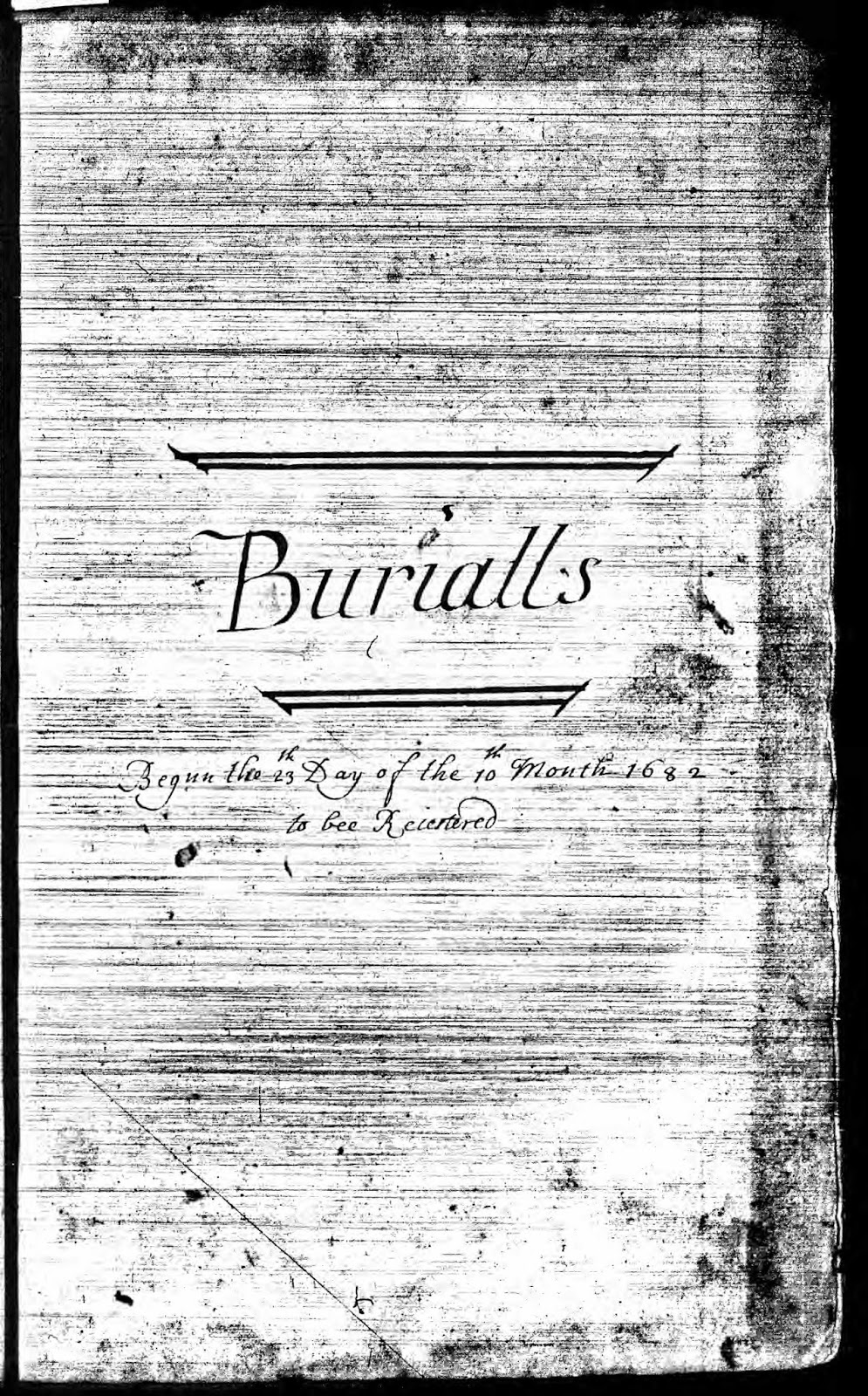
Title page of the section of Chester
Monthly Meeting "Burialls" records
"Begun the 23rd Day of the 10th
Month 1682 to be Registered".
Quaker were (and still are) meticulous record-keepers of the actions taken by their meetings, and of individuals within those meetings. In the early days, careful record-keeping was a matter of self-preservation, since Quakers were barred from access to the government institutions that kept vital records for others. Friends' births, deaths, and marriages were not recorded anywhere but in the minutes of each meeting. As a safe-guard, this vital information was re-recorded by the quarterly meeting (a collection of meetings within one area), and by the yearly meeting (a gathering of representatives from the quarterly meetings).

Quaker records weren't confined to vital statistics, however. Quaker minutes recorded a meeting's response to local and national issues in light of Quaker beliefs and practices, and reminded Friends of their duty and obligation to conduct their personal, family, and civic lives in accordance with Quaker principles.

Most importantly for researchers, Quaker minutes often afford insight into the conduct of our individual ancestors. A Friend who was particularly devout and whose words and actions were inspirations to other Friends might be appointed to a "ministry". (Such an appointment was not an elevation in a Friend's position, as that would result in inequality; it was a formal recognition of an individual's gift for helping others in their spiritual journeys.) Minutes record both the issuing and the receipt of certificates of transfer which enable a researcher to trace the movement of ancestors, and also confirm an ancestor lived her life in accordance with Quaker principles.

Whenever a major life decision was made, or whenever a friend was found to be "out of discipline", the meeting appointed a committee of two to three exemplary Friends to "treat" with the Friend. When a couple announced their intention to marry under the care of the meeting, a committee met with them to offer guidance, and to ensure both were members in good-standing. (The latter examination was especially important when a prospective spouse was from another meeting.)

When a Friend behaved in ways that were contrary to Friends' teachings, a committee counseled the Friend. All committees reported back to the meeting, and those reports were included in the minutes. The meeting as a whole then decided on a course of action, which was, of course, entered into the minutes. (By the way, Friends did not/do not vote on any matter. There is discussion--but not debate. Friends are then asked if they approve an action, and there must be complete agreement; a single dissent means the action cannot be undertaken.)

Minutes of Friends' meetings are a treasure trove for the researcher, and locating this information is not difficult. One of the most complete published sources, available in most libraries, is William Wade Hinshaw's 6-volume Encyclopedia of American Quaker Genealogy. The fully-indexed volumes consist of abridged vital and membership records, arranged by area and meeting. In addition to Hinshaw, others have compiled the records relating to just one meeting, such as Hopewell [Frederick County, Virginia] Friends History, 1734-1934.

Three years ago, Ancestry made available images of original records in the collection "U. S., Quaker Meeting Records, 1681-1935". About 80 percent of American Quaker records---11 million names!-- can be found in this collection. The early (17th and 18th centuries) records are sometimes challenging to read, but definitely worth the effort required.

The minutes of Abington Friends Monthly Meeting in Jenkintown, Montgomery Co., PA record the births
of three children of my 7th great-grandfather, William Carver: Sarah, born to William and Jane in 1690, and 
William, Jr. (my 6th great-grandfather) and Joseph, born to William and his second wife, Mary, in 1694 and 1696.

If you can travel, the archivists at these college libraries can be very helpful, plus you can see the actual records: Friends Historical Library, Swarthmore College, Swarthmore, PA; Hege Friends Historical Library, Guilford College, Greensboro, NC; Earlham College Friends Collection, Richmond, IN; Quaker Meeting Records, Haverford College, Haverford, PA. But if you can't travel, you can contact these repositories by email or letter for research assistance.

A note of caution. There are two aspects of Quaker minutes that confuse the non-Quaker researcher and lead to misinterpretation: the copious use of abbreviations, and the particular way of recording dates. At Cyndi's List  (https://www.cyndislist.com/quaker/how-to/) you can get a list of abbreviations used in Quaker minutes. An excellent explanation of how to interpret the date recorded in minutes can be found at the "Quaker Dates" section of the Guildford County, NC GenWeb site (http://ncgenweb.us/nc/guilford/quaker-dates/).